
The Consensus Trap

You want your app to be a hit.
You want it to be helpful and profitable.
The easiest way to do that is to satisfy existing demand in the market.
How do you find demand?
People say you should talk to your customers. That’s true—but there’s a trap.
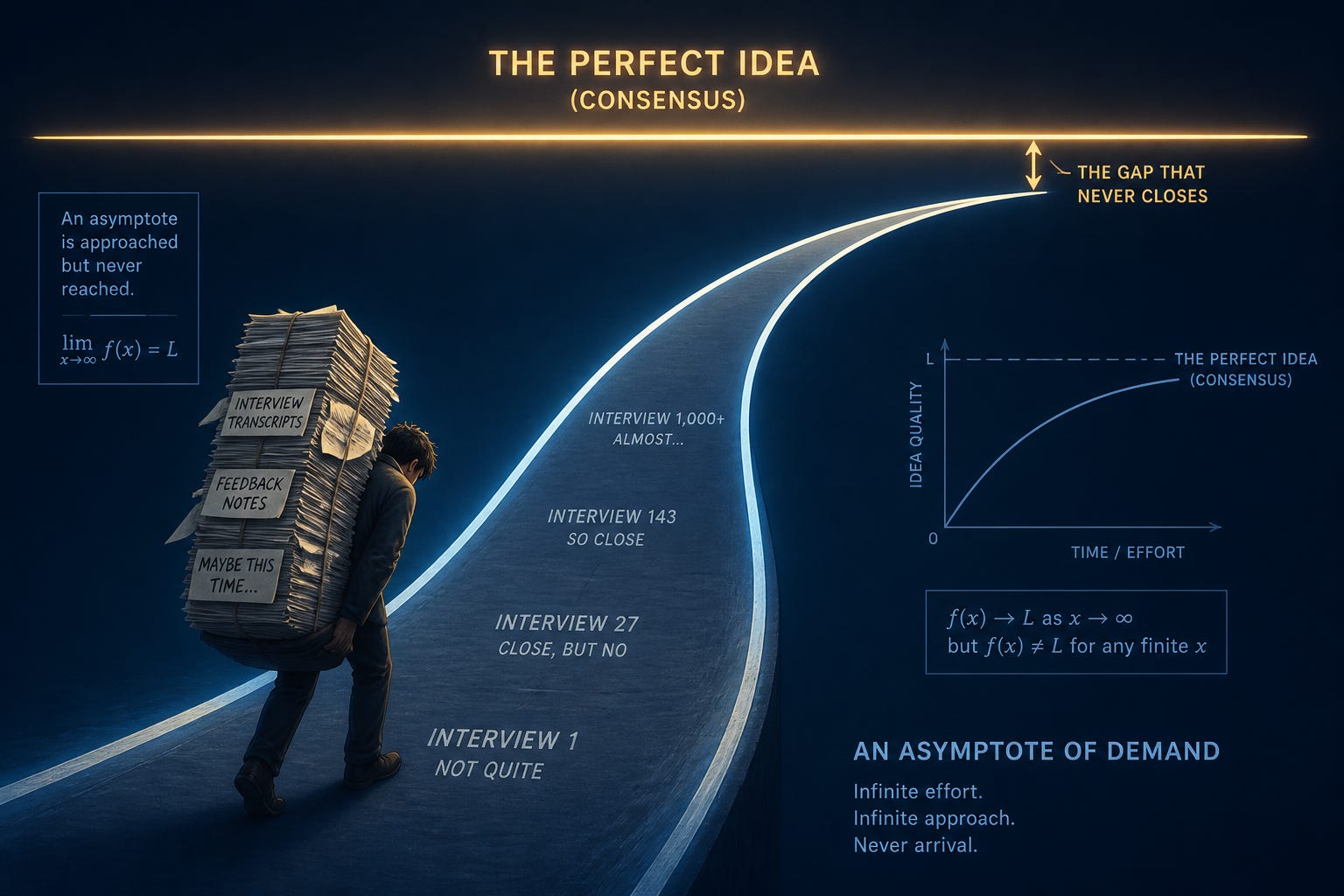
Demand discovery by consensus
A year and a half ago, I spent six months doing 56 discovery interviews with commercial AV managers. I was trying to find the perfect idea for a micro-SaaS business.
Common business advice is to talk to customers, discover their problem, then build the solution.
The way this is supposed to play out is that you talk to five or six people, they all say, “I have problem X”, then you build a solution for X.
But in my experience, this never happens, and is in fact a trap, especially if you are prone to overanalysis, like me.
After 15 interviews yielded no clear overlap, I didn’t pivot. I just doubled down, hoping that if I kept hoarding information, the answers would magically surface. But demand by consensus is an asymptote—you gather more and more data, you feel like you’re getting closer to the answer, but you never actually touch it.
Arguing with AI
I wanted a shortcut so badly that I built custom AI tools to review my discovery transcripts. I fed all 56 interviews into an LLM and asked it to find the demand and tell me what to build.
But LLMs couldn’t figure it out either, because the overlap didn’t exist. The AI would start grasping at straws: “You should build a labor app!”
I had to talk it out of its own ideas: “But only one person actually asked for that.” “Oh yeah, you’re right,” it would reply.
It’s a crestfallen feeling. Your stomach hurts. You put all this energy into a shortcut because some part of you feels like you aren’t smart enough to figure it out on your own, and then even the shortcut just shrugs at you.
“We Don’t Have Problems”
Recently, I tried the discovery process again. Just five people.
This time, I asked mid-sized AV company owners where they were spending too much time. At least three of them told me: “We don’t have any problems. We’ve been refining this process for 20 years.”
Demand, at its core, means someone is willing to pay for a change. Even if they casually say they want to improve, the moment you offer a $100/month solution, the answer is no. It’s the money, but also the time to learn a new tool, integrate it into an existing workflow, and get stakeholders to buy in.
Hearing this over and over triggered my lizard brain. In those interviews, I’d get emotionally hijacked and defeated. I’d start pitching them random ideas, essentially fishing for validation. Please tell me I’m good enough.
I realized you just can’t do successful customer discovery when you’re secretly demanding emotional validation from the person on the other end of the Zoom call.
Taking the Boot Off My Neck
What finally changed? I got a part-time job.
With the boot of capitalism slightly off my neck, the pressure to immediately find a scalable B2B SaaS with 100 paying customers disappeared. I finally had the time and space to stop looking for 15 people to agree and find one problem for one person. Honestly, I could have done that all along—but going slow never seemed like an option.
That person is Chris. His specific problem is building production schedules. He spends hours converting meeting transcripts into planning documents and a final production schedule. He cares about delivering excellent service to his clients, and he doesn’t want to let anything fall through the cracks.
Instead of asking 55 other people if they also wanted this, I just started building it for him. It’s called ShowBook.
Go Slow. Focus. Integrate.
Because I’m only building for one person right now, it changes how I code.
My instinct over the last couple of years has been to go fast and throw AI at every wall I hit. But relying entirely on LLMs to write the code meant I didn’t deeply understand the underlying data flow, which just baked in layers of “AI slop” and technical debt.
Now, I’m building in small vertical slices. I am forcing myself to conceptually understand the architecture and flow of data using event modeling.
After Chris and I got off the phone, and he agreed to pay for the first version, he sent me a photo of his water bottle. It was engraved with his focus words for the year: Integration / Wisdom / Focus.
That’s the new approach. Go slow. Don’t scale. Focus. Integrate.